

On Friday, October 21, the Norris Group proudly presents its 9th annual award-winning black tie event I Survived Real Estate. An incredible lineup of industry experts will join Bruce Norris to discuss perplexing industry trends, head-scratching legislation and opportunities emerging for real estate professionals. Proceeds for the event benefit Make a Wish and St. Jude Children’s Research Hospital. This event is not possible without the generous help of the following platinum partners: HousingWire, PropertyRadar, the Apartment Owners Association, the San Diego Creative Real Estate Investors Association, InvestClub for Women, MVT Productions, the San Jose Real Estate Investors Association, Inland Empire Real Estate Investment Club, Think Realty, and White House Catering. Visit www.isurvivedrealestate.com for event information and tickets.
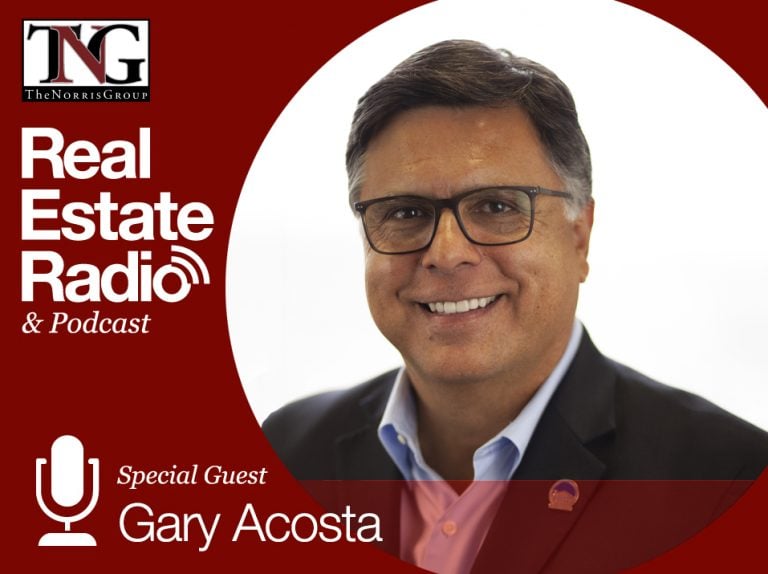
Bruce Norris is joined this week by Gary Acosta. Gary is the co-founder and CEO of the National Association of Hispanic Real Estate Professionals (NAHREP) and a 25-year veteran of the housing industry. NAHREP is the nation’s largest minority real estate trade organization. With over 20,000 members and 40 local chapters in his capacity as CEO. He created the Hispanic Wealth Project, a new 501 C3 non-profit organization with a strategic plan to triple Hispanic household wealth by 2024. He also co-founded several mortgage real estate and technology companies, including New Vista Asset Management, Counter Max, and Real Estate Español.com. In 2013 he co-founded the Mortgage Collaborative, a cooperative of mortgage companies that work together to increase profitability and market share.
Episode Highlights
-
- How big is the Hispanic population in our country, and how do they contribute to the market?
- What is the concept of simple assumption, and how does it relate to real estate?
- What is the current homeownership rate now compared to before?
- What does the typical household look like today, and is it the same as it was before?
- How many Hispanic households fit into the millennial group?
- His play about the Latino market called “53 Million & One”
Episode Notes
Bruce said the first thing that came to mind was he doesn’t really think of Hispanic households as anything other than us. Gary said when he started 15 years ago, he told people the market was coming and would make a big change in the industry. He does not have to make this case anymore because it is clear this is not just a niche market anymore. This is part of core market in general now.
When we talk about the needs of the Hispanic household, we are really talking about the needs of across the board households. There are only a couple caveats, and Bruce wondered what these are. Gary said many Hispanics come from immigrant backgrounds and are predominately news to the process. Therefore, most Hispanic homebuyers are still first-time homebuyers. Even though they are earning more money every year and increasing their educational payment, there is a pretty substantial wealth gap. First-time homebuyers generally need low down payment mortgages and sometimes help with down payments. There is also a whole cultural piece as well where 25% of Hispanic homebuyers prefer to negotiate the transaction in Spanish. These nuances create both challenges and opportunities for the industry in a substantial way.
Bruce is in the process of loaning to investors, and his company just got a call from a Hispanic-speaking person. However, they did not have paperwork for him. This is a challenge because he does not want them finding something they do not understand. Bruce asked if Hispanic paperwork is becoming needed, or is it more leaning toward the Hispanic household needing to learn English. Gary said he thinks it is both. For any business, you can wait for the consumer to come to you or you can go where the consumer is. There is still a substantial part of the Hispanic population that needs in-language support, whether through marketing collateral or the disclosure process. Gary does not expect to be signing Spanish language loan documents any time soon because those are legal documents that need to be recorded. It is a much more complicated process to get to that point. The documents that assist the buyer to understand the process and help them make intelligent choices about what particular service or loan they should pursue are needed. There are companies providing them, and one organization out there is disseminating that information as well.
One of the problems with the downturn is we went too far with programs. The things helpful now were part and parcel to what went on with the extended version. Down payment assistant programs existed prior to 2005-2007. In all of this there was nothing low down, and it has a connective tissue to being very damaging and something you do not want to do. Bruce asked how you start that up again without raising the hair on the necks of the people. Gary said there were people who got mortgages back in 2008 before the crash who should not have gotten them. They were not prepared for it, nor did they have the financial stability to make that successful experience for them.
When we look back and see what things led to the crisis, it was not really about people getting a down payment assistant mortgage on an FHA loan or Fannie Mae/Freddie Mac product. Generally people were getting 0 down transactions from subprime lenders or loan products that had teaser rates and were likely to increase in terms of payments in a very short period of time. Those were really the ones that got people into trouble. People who got fixed-rate mortgages and conventional mortgages generally did pretty well. Some of that got lost in the smoke of the crash, and now they don’t want to do it again since it ended badly last time. Now we have different sets of rules and lenders have to validate income and capacity in a way they did not have to prior. Generally these types of things are not as big a problem as they were back then. Gary thinks the market is now ready for this kind of thing.
Bruce agrees with the concept of a nothing-down loan being very safe. He thinks it should exist because we have a really unique opportunity in having an interest rate that starts with a 3. We could have a lot of homeowners lock in the biggest build they will have in their life at a very low rate. As the earning grows, that becomes less of a factor. Bruce and Gary would have experienced this in their own lives as they signed up for a house payment that could be almost $200. Before 5 years went by, it was half of Bruce’s car payment, and it was like he did not have a house bill. This was between 1974 and 1980 when prices went crazy.
However, this gives people a chance to lock in the housing cost; and if you are a renter this never happens. It always floats to the biggest bill you have. Gary said we have had 0 down payment mortgages for 50 plus years, and they are called VA mortgages. These loans have performed exceedingly well through both good markets and bad markets. We know the product itself is not the problem, but rather it has been the execution of the product and the way we went about qualifying people.
Bruce said when he was first in the business back in the 70s, we had something called a simple assumption. FHA would have a loan in place, and interest rates started going crazy. However, there was a whole pile of interest rates that were reasonable at 7-8%. This seemed reasonable because the new rate was 15%, and you could take over a loan with simple assumption. You fill out one sheet of paper, send it to FHA, and say you are the new buyer. You would then give about $45, take the other person’s name off, put yours on, and that was it. There was no qualifying process.
If you created a mortgage product today that was underwritten properly with nothing down and had the ability to move to another buyer in case of failure. They could then do a simple assumption, and the only criteria is the loan be current when it closes. You could have homeownership go back up to a reasonable level very safely and create virtually no foreclosures. That loan that starts with a 3 would either walk to a new owner-occupant or to an investor. We may see this again since these were terrific programs that got a lot of people into homes and resulted in situations that were challenging for other families. They were kind of a win-win, and we lost a lot of that during the heyday of the prime marketplace with some of the loan products that became the root of the problem. Gary would be enthusiastically supporting of the return of some of these products.
On the I Survived Real Estate panel in October, there will be a lot of people who are key to some of these discussions. They have spoken in Washington, and Bruce said he has had conversations with people who have made things happen. Gary Acosta will be a part of this panel at the event.
Homeownership had over 60% nationally, and now we are down multi-decades low. Bruce wondered what the journey was for Hispanic household and what they had gone up to or if they have been as negatively impacted by what happened. Gary said the Hispanic homeownership rate has traditionally lagged the general market rate for a couple reasons. The number one reason a lot of people don’t recognize is the Hispanic population is so much younger than the general population. The two biggest metrics with respect to predicting homeownership is income and age. Hispanics are 10-20 years younger than the general population, depending on the market. Because of this they will have lower homeownership rates.
The rate in the year 2000 was roughly around 46%. That rate got up to 50% in 2008, which was the peak of the market. Just like the general market it started to rescind after that, and it has gone down every year except for last year. Last year the general market homeownership rate dipped for the 12th consecutive year, but the Hispanic homeownership rate increased and was the only ethnic demographic that did during that period of time. A lot of enthusiasm for homeownership has remained within the Latino population. It is really the growth engine for the marketplace today and perhaps for the foreseeable future.
Bruce asked if a great many of Hispanic households fit into the millennial group, or is it older than that. Gary said 26%, or more than a quarter, of all millennials are Hispanic. The average or median age of a Hispanic individual is 35, or mid-30s. The general population is closer to late 40s-early 50s. It is substantially younger and entering those prime homebuyer years. Another interesting fact is Hispanic households are twice as likely to be made of two parents and one child. It is very much the common issue with Hispanic families, and this is not the case with the general market, which is now much more likely to be single and people getting married later.
The wide population is moving in large numbers into retirement years as well; so the question is who will come in and buy those starter homes or fill those workforce needs. More often than not it is Hispanic families coming in and filling those gaps. If you look at the projections for population gain, especially in California, the Hispanic population will be the driver. One of the things the California Association of Realtors does to demonstrate that point is they track the most common surnames of homebuyers every year. The number one most common surname last year was Garcia. 8 out of the 10 most common surnames were Hispanic, specifically in California.
John Burns just did a book on demographics, and one of the things he pointed out was that household is not made up of the two adults and 1-2 kids. By in large it is something different, and this changes how people qualify. Just now you have a single adult and a kid, and this is a different group that will less of an ability to qualify for financing. The household has definitely shifted, and with people forming households later you see how people aren’t even doing at 30 what people before were doing at 20. The households are very different, some multi-generational and others structured differently. This affects the way people qualify for mortgages today, and the market needs to adjust to this. It is not only a Hispanic phenomenon, it is a general market phenomenon.
Bruce often writes reports about what is coming next, and one of the things where Bruce can really see a stark difference is the wealth of retired people owning a home versus those who don’t. Those near poverty level don’t own a home, and if you do you will make it fine. Because housing went through this crash, it became very popular to say it doesn’t make sense to own.
Gary was involved in writing a play about a gentleman’s life named Jerry. The show is called “53 Million & One,” and it is something that is not common for a trade association or real estate practitioner to dabble in theater. Gary said his organization has always looked for different ways to communicate their message and help people understand the Hispanic experience better. They can then de-mystify the process of serving in the Hispanic community. You can do that in presentations, video, and different mediums.
They stumbled on the idea of creating a theatrical presentation for two reasons. One is he had seen Mike Tyson’s one-man play “The Undisputed Truth.” He narrated his life to music and video, and he thought this was a medium he could also utilize to tell his story too. Gary has a friend who had an incredible story and was a really great speaker, presenter, and professional musician. They decided to use his story as a model, and they created a script around his true life story. They called it “53 Million & One” because it is in reference to 53 million Latino stories in America, and this is just one of them. He walks you through various times in his life, including when he first immigrated to the country at a young age all the way to the challenges, successes, triumphs, and setbacks along the way to where he is today. He is a successful real estate broker with an amazing family, and he is living the American dream.
Bruce puts a lot of weight onto owning a house. He got married at 17, and he really struggled in the beginning having been fired five times in a row. He saved $20 once in a while in a can, and he finally got it to where it was a down payment. He was 21 when he bought his first house for $21 grand, took over a VA loan with $500 down. When he speaks in front of people, he still gets the emotion from mowing his lawn for the first time at his own house. This was the first time he really felt like a man. This is how powerful that experience was. He didn’t have a dime or equity, but he did have a grant deed. Deep inside of that space he got to call the shots for the first time, and it felt good. People deserve this shot.
There are people out there challenging whether homeownership has the same appeal as it once did, whether or not it is the best financial decision. There is something tangible about buying a home for all the reasons that Bruce laid out. For Hispanics in particular, many gravitated to the real estate business because the idea of owning a home was at the top of the list in terms of aspirations. This is where the family congregated and celebrated their love for one another and growth. The house itself plays a much bigger role than solely an investment.
Bruce wrote a report in 2006 called “The California Crash.” He expected prices would go down, even by half in a worst case scenario. He owns an expensive home in Riverside, and he is contemplating selling it because he knows it will go from $1-$2 million to $600 grand. He actually made the phone call to be a renter. He called someone up who had a good house in Riverside, telling them he was not their typical renter and will pay a year in advance. Bruce was then asked if he had any pets. After pausing he said he was glad he asked this because he does not ever want to have to answer this again. He ended up selling it for half, and he could care less because he still got to call the shots in his square box.
Thank you for tuning in. Gary Acosta can be heard at I Survived Real Estate 2016, where he will be featured on the panel.
Thank you for joining us this week for the real estate radio show with Doug Duncan. The Norris Group would like to thanks its gold sponsors for supporting I Survived Real Estate: Auction.com, Coachella Valley Real Estate Investors Association, Coldwell Banker Town and Country, Elite Auctions, In a Day Development, Inland Valley Association of Realtors, Jennifer Buys Houses, Keller Williams Corona, Keystone CPA, Las Brisas Escrow, L.A. Green Designs, LA South REIA, New Western, North San Diego Real Estate Investors, Northern California Real Estate Investors Association, Orange County Investment Club, Orange County Building Industry Association, Pacific Premiere Bank, Pasadena FIBI, Pilot Limousine, Real Wealth Network, Realty411 Magazine, Realty Executives Inland Empire, Rick and Leanne Rossiter, Sonoca Corporation, South Orange County Real Estate Club, Spinnaker Loans, uDirect IRA Services, Westin South Coast Plaza, Wholesale Capital Corporation, and Wilson Investment Properties Inc. See www.isurvivedrealestate.com for sponsor links and event information
For more information about The Norris Group’s California hard money loans or our California Trust Deed investments, visit the website or call our office at 951-780-5856 for more information. For upcoming California real estate investor training and events, visit The Norris Group website and our California investor calendar. You’ll also find our award-winning real estate radio show on KTIE 590am at 6pm on Saturdays or you can listen to over 170 podcasts in our free investor radio archive.