

On Friday, October 21, the Norris Group proudly presents its 9th annual award-winning black tie event I Survived Real Estate. An incredible lineup of industry experts will join Bruce Norris to discuss perplexing industry trends, head-scratching legislation and opportunities emerging for real estate professionals. Proceeds for the event benefit Make a Wish and St. Jude Children’s Research Hospital. This event is not possible without the generous help of the following platinum partners: HousingWire, PropertyRadar, the Apartment Owners Association, the San Diego Creative Real Estate Investors Association, InvestClub for Women, MVT Productions, the San Jose Real Estate Investors Association, Inland Empire Real Estate Investment Club, Think Realty, and White House Catering. Visit www.isurvivedrealestate.com for event information and tickets.
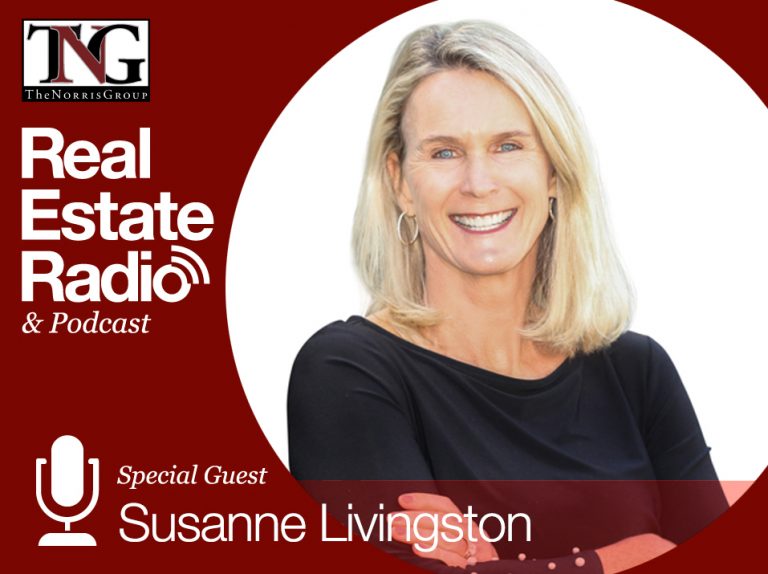
Aaron Norris fills in this week for Bruce Norris, who is in Washington D.C. talking with government officials about what today’s radio show is about: financing. He is joined today by Susanne Dawn Livingston, who is the Executive Vice President of sales and marketing of Residential Wholesale Mortgage, Inc. RWMI is a privately held company that was founded by her husband Brad in 1994. It was recognized by the San Diego Union Tribune as a top workplace in 2015 and also named one of the top privately-held mortgage companies in San Diego by the San Diego Business Journal. She currently serves on the board of the California Mortgage Bankers Association, and she has been in the industry since 1986 when interest rates popped out a beautiful 11 ¾%.
Episode Highlights
-
- What is the current status of the Dodd-Frank Act created in 2010?
- Where is homeownership at, and has it improved or declined over the years?
- Are there any loan programs in the coming years that could contribute to homeownership?
- How well has the VA program performed?
- Where do overlays originate: the government or private companies?
- How does the mortgage industry currently view the GSEs?
- How has technology changed the mortgage industry?
Episode Notes
Dodd-Frank was rolled out in 2010, and Aaron wondered where we are at now and why it has taken so long. Susanne said we are likely seeing a light through the tunnel. We have 10% of the rules and regulations to go, but we have successfully lasted this long. Therefore, she sees this moving forward with a new application that will be implemented through their LLS systems and various software integrated with the systems. Aaron asked if this is one of the last things that has to happen when the last application rolls out. Susanne said one would hope so, but with the way the CFPB is delving into the different regulations, it would really depend who wins the nomination. This will be very instrumental in the direction of future law and rule-making.
Dodd-Frank was rather bipartisan when it first came out, and Aaron asked if it has gotten more political as we have gone along. There have been several in the House who are still trying to bring some reform to the CFPB. Nothing formally has been adopted yet, and we are really waiting on the elections. The GOP wants to see an overhaul, especially with the recent PHH ruling. There is a firm belief that some think it is a bit overreaching and perhaps unconstitutional in the way it is being run. They are left to their own devices as far as being able to regulate and levy fines.
The PHH is a lawsuit against the CFPB for a fine that was levied. Susanne said there are several cases pending now, and the big controversy is some want to see the CFPB under Congressional oversight as opposed to the autocratic structure it is now. There is some bipartisan support to this, so that would be a more balanced approach as it is today. It has grown in terms of numbers, and the federal agencies have increased by some as high as 40% since 2010. It certainly increased the regulation on business owners and their day-to-day functions.
Aaron asked Susanne if she were to give the CFPB a grade from A to F what it would be. She said originally there were a lot of disappointed people who lost their homes and it was a terrible downturn in the economy. However, some of the regulation that came out of it has been very positive. We have a national MLS licensing system, and parts of this are very good. The fact that appraisals are a little more regulated is good too. However, in terms of the broad oversight on loan officer compensation and implementation on their audits has put more stress on companies. They feel it is more of a taxing authority and somebody looking to support their employment and keep their job afloat.
It has also gotten a little more expensive to be in the business. Susanne said she did not have compliance department 8 years ago. Now they not only have a compliance department but also extra people for disclosures in order to keep up with the TRID. Now their software and everything has to be more complex in order to do the recording that is demanded from the regulations. Aaron said it seems smaller companies would have a harder time keeping up with all those schedules. Bruce asked if the organization has seen a shrinkage in the very small shops. Susanne said if some of the brokerage shops and smaller mortgage bankers did not have a good cash position in 2008 may have lost their lines of credit, shut their doors, or converged with a platform. In 2008 it was either grow or perish, and unfortunately there were smaller players who either got out of the business entirely or were forced to merge with somebody bigger.
Aaron said homeownership is currently at a multi-decade low, and he wondered if this was an unintended consequence of all the regulation or just demographics. Susanne said there are a lot of factors here. You have 2008 when people owned their homes and were upside down. Millennials who saw their parents go through that stress thought buying may not be a good thing. You saw a lack of jobs for kids coming out of college and slow unemployment. This was coupled with high prices, especially in California, and high student debt. Susanne said as an industry they are really focused on educating those first-time homebuyers and educating the parents and grandparents about the great programs out there that can get the first-time homebuyers entering as investors. It is possible the investment properties are penciled better for first-time buyers, so we really need to look at the programs available today.
Susanne said if the grandparents are fortunate to be passing on money to their successor family generations, then it can be used for 100% of the down payment for the millennials or their own kids. In terms of financial planning, they are starting to look at this and educate people on how they can leave a legacy for their children. Aaron, being a Gen-Xer, knows some of his best friends have no desire to own. He thinks this is really interesting marketing strategy and very appropriate. Aaron’s best friend just bought a home, and it was a gift from a family friend. The down payment was necessary, or it would have been very onerous.
Aaron asked Susanne if she sees any loan programs coming out or any policy changes in California that will make first time homeownership easier. Susanne said we are really trying. Freddie Mac and Fannie Mae have done an excellent job in relaxing some of their overlays, which is something that hinders homeownership as opposed to helping it. Freddie Mac and Fannie Mae are helping, and the jumbo investors are also trying to go along that line. A non-occupant co-mortgage income was one of Freddie Mac’s, and now you have Fannie and Freddie both doing it. Trends like that have happened.
You also see multiple financed properties and how they were stricter on these, and reserve requirements for the jumbos are still very tricky. You have to watch the overlays, and they are still seeing the season requirements for short sales and foreclosures. They are trying to navigate their borrowers to a roadway to success while they are in that waiting period. Aaron asked if it has changed at all or if it is still 3 years for short sale and 7 for foreclosure. Susanne thinks it is actually 4 and 7, but she thinks FHA is 2 and a little more lenient. When you looked at the down payment requirement, FHA was always the leader there at 3 ½%. Then you saw the GSEs come in with the 3%. We cannot forget about our veterans, who we want to take advantage of 100% financing. If this goes above the maximum allowable, they just put in 25% of the difference. There has been a lot of success with the veteran community, especially in San Diego. Yet there are surprisingly many veterans who have never used their entitlement.
The VA program has been one of the best performing, even during the downturn. When talking about the foreclosure process, it’s good to bring up how the VA program has still remained at 100% financing. It is a solid program and did not experience what some of the other GSEs did as far as foreclosures. Aaron asked Susanne if there is anything missing as far as lending programs she would like to see in the mortgage industry that would excite people and maybe loan a lot more money. Susanne said she would like to see a safe harbor loosen up a little, and in her market down in San Diego County they have a fair amount of jumbo products. The 43% back-end debt ratio for self-employed individuals who have significant savings can pay off their loans in many cases. For them to not receive a loan as not as easily as they could is a little disheartening.
Susanne is a big fan of interest-only, and there is a reason and a place for this. As long as mortgage professionals are giving customers choices and explaining when that is appropriate, it is an excellent product. There has been no decrease in down payments on FHA or Fannie and Freddie. There are already excellent options since those down payments can be gifts. The reserve requirements area very reasonable, especially with the good credit. However, other than that she does not really think we have a whole lot of options right now.
Susanne had said with owner-occupied homes she is seeing up to ten. Notoriously anything over 4 was extremely painful, so Aaron wondered if she has seen this get any better. Susanne said the new underwriting for the income on investment properties is different, and there are stricter reserve requirements the more properties you have. They have relaxed the loan-to-value requirements a little, and over 75% is still the best pricing. However, you can go 80% and there are even some at 50% down. She always encourages her borrowers to go 75% if they can, but from a risk standpoint investment is certainly at a higher risk than owner-occupied properties. Likely they will always continue to err on the side of caution there.
Aaron tried to do a refi earlier this year, and it was extremely painful. All he was doing was a rate change. He wasn’t even changing the term and was in a good position, but they made it so painful that he eventually gave up and could not do it anymore. Susanne said she spends a lot of time training her loan officers to set expectations. She wants them to under promise and over deliver. People ask her how long she can get the loan done, and she asks them how quickly they can get her list back to her.
As a hard money lender, Aaron tries to stay on top of things. He said one of the interesting things was how technology was a factor. They had this go-between system where he was going in trying to sign paperwork, and they kept on uploading the wrong paperwork. He kept trying to tell them they were not his loan documents and the numbers were all wrong. They would tell him to sign it anyway, and he said he was not signing any numbers that were wrong.
Aaron asked which way overlays come, whether it is from the government overlays or private companies overlaying their own rules to make sure they are compliant, especially with Dodd-Frank continuing to roll things out in the future. Aaron wondered if it goes both ways. Susanne said in terms of overlays every company is at will to create their own overlays based on what they perceive as written. You may have an institutional bank, for example, like Wells Fargo whose overlays are different from Chase’s and are a more direct seller to Fannie Mae and Freddie Mac. Overlays should be light as possible at certain levels, such as investment properties and others you may carry. These are all things that vary.
Aaron next talked about affordability in California and how it has really become an issue. Aaron asked how the industry in California is discussing this and if the affordability will stall sales in the coming few years. Susanne said she does not think we will see a change in more co-borrowers in order to get around this. You may have to look at multi-family where you have income for the property coming in to offset the mortgage payment on an owner-occupied basis. She said affordable housing is a big problem in San Diego and Orange County for first-time homebuyers. It is possible they are going to have to wait.
Millennials are happy renting and many are even switching jobs every three years. They are not settling down quite yet and not ready to be married. It may require double income. Aaron asked if the mortgage industry is excited about there possible being more family units in the next ten years. Susanne said absolutely and this is the big topic of discussion, especially with the population expansion. When you read about all this, you see how there could be another big bubble, it’s just a question of when.
Aaron asked what the mortgage industry thinks of the GSEs, whether they will go away, change, merge, or form a new entity. Susanne said she does not think the GSEs can go away with the government basically buying 95% of our product today. When they went into receivership nine years ago, it was written in their bi-laws they could go into receivership. However, there was never anything written saying they could go back to privatization. She thinks there has been some reform with the GSEs and push towards more reasonable profits.
Something that has come up on the Hill is how we have already gotten out of the big hole and had so much cash reserves in the GSEs that they wanted to build roads with the money they had. The MBA backed it as well, and there was a big push for them not to take the money since it was for homeowners. Until we go through elections and see who will be in power, nothing is going to happen quickly. From what she has learned about politics, it takes at least 5 years to switch that big boat even if you do want to reform it. She thinks we will see some changing and updates as well as some reform, but it will happen very slowly.
We are only about a month out from the election, and Aaron wondered if there is a plan A and plan B route depending on who is elected. Aaron does not think either candidate has focused a lot of time on housing affordability. Aaron asked if the communities are concerned about this. Susanne thinks the consensus is if we have more of the same if the Democrats stay in power. They already have Dodd-Frank in place, are implementing this, and have geared it up. If the Republicans gain control and shake it up a bit, they may not get rid of and make drastic changes but will evaluate. Everyone wants to make sure there is oversight and that it is more reasonable from a GOP perspective. David Stevens of the Mortgage Bankers Association recently came out saying lenders need clear, consistent, and reasonable interpretation of the rules in order to best serve their borrowers and contribute to a smoothly functioning real estate market. Bill Cosgrove, who was the Chair of the MBA a few years ago, also said the penalty phase is still happening. Once the banks stop getting sued and paying all these fines, then maybe more private money will enter the system. However, we have already talked about the GSEs being 95% of that market.
Aaron asked if this is really the problem and if the penalty phase is really over, if there is absolute clarity, and Dodd-Frank is through the system. He wondered if more private money will come in once this all happens. Susanne thinks interest rates are at an all-time low, and as those interest rates come up she thinks it will be more attractive for investors to get off the sidelines and get back into the marketplace. There is a balance between the yield on interest rates, and in terms of the other side it is a very interesting world we live in today.
Aaron and Susanne ended with the topic of technology and whether it is changing the mortgage industry. He wondered how small and medium-sized banks are dealing with all the changes. Susanne said technology is actually her favorite thing and it is completely turning the industry upside-down. She said when Zillow started people were confused about where they were putting their properties. It has evolved into so much more with all the internet marketing. Before you had 25% of the people going online to buy a home, and now you have 90%. Their company is involved in a consumer-direct platform, and there are people willing to do everything online today.
In order to keep up with that, they have the online loan applications, mobile apps, and loan origination software. It will blend our cultures from boots on the ground to straight internet lending. We will always need a traditional format since an internet platform cannot really take time to help that difficult borrower who may be credit-fixing. They may need significant help with the roadmap to get them where they need to go. There will be a section of the population made of cookie cutter borrowers with the mindset of “get them in, get them out.”
Thank you for joining us this week for the real estate radio show with Susanne Livingston. The Norris Group would like to thanks its gold sponsors for supporting I Survived Real Estate: Auction.com, Coachella Valley Real Estate Investors Association, Coldwell Banker Town and Country, Elite Auctions, In a Day Development, Inland Valley Association of Realtors, Jennifer Buys Houses, Keller Williams Corona, Keystone CPA, Las Brisas Escrow, L.A. Green Designs, LA South REIA, New Western, North San Diego Real Estate Investors, Northern California Real Estate Investors Association, Orange County Investment Club, Orange County Building Industry Association, Pacific Premiere Bank, Pasadena FIBI, Pilot Limousine, Real Wealth Network, Realty411 Magazine, Realty Executives Inland Empire, Rick and Leanne Rossiter, Sonoca Corporation, South Orange County Real Estate Club, Spinnaker Loans, uDirect IRA Services, Westin South Coast Plaza, Wholesale Capital Corporation, and Wilson Investment Properties Inc. See www.isurvivedrealestate.com for sponsor links and event information
For more information about The Norris Group’s California hard money loans or our California Trust Deed investments, visit the website or call our office at 951-780-5856 for more information. For upcoming California real estate investor training and events, visit The Norris Group website and our California investor calendar. You’ll also find our award-winning real estate radio show on KTIE 590am at 6pm on Saturdays or you can listen to over 170 podcasts in our free investor radio archive.